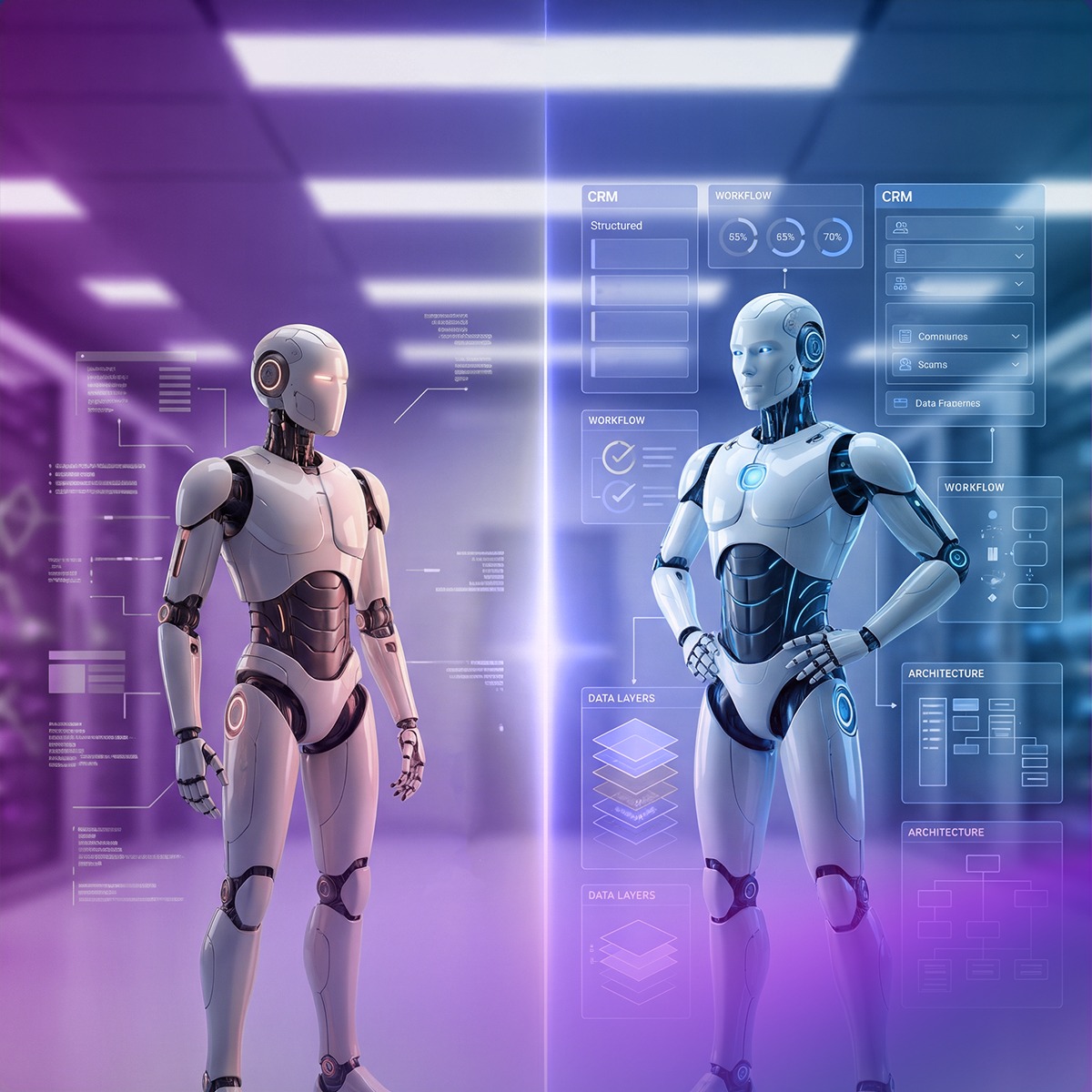
Genesys AI Agents vs AI-Native Agents

Genesys offers AI agents inside its contact center, but how do they compare to AI-native agents? This practical guide explains the real differences in architecture, deployment, data handling, cost, and enterprise impact—and how Wittify fits into a modern AI stack.

A Practical Enterprise Guide

As enterprises explore AI automation, one phrase keeps coming up:

“We already have AI agents in Genesys.”

But when teams start deploying, integrating, and scaling automation, a deeper question emerges:

Are AI agents inside CCaaS platforms the same as AI-native agents?

The short answer is: no.

This guide explains the practical difference between Genesys AI agents and AI-native agent platforms, why the distinction matters for enterprises, and how to decide which approach aligns with your long-term strategy.

First, let’s clarify the terminology

What enterprises usually mean by “Genesys AI agents”

In the Genesys ecosystem, “AI agents” typically refer to:

  • Virtual agents (chatbots / voice bots)
  • Built using flows, intents, and dialog logic
  • Enhanced by:
    • ASR
    • TTS
    • LLM integrations
    • Knowledge lookup (RAG)
  • Optimized for contact-center efficiency

These agents are powerful within the CCaaS context and work well for:

  • FAQs
  • Guided interactions
  • Deflection
  • Human-assist scenarios

What we mean by “AI-native agents”

AI-native agents are built on a different assumption:

AI is the system, not a feature layer.

They are designed to:

  • Reason
  • Decide
  • Act
  • Validate
  • Execute

Across channels, data sources, and business systems.

This is the category Wittify operates in.

1. Architecture: Flow-based vs Agentic

Genesys AI agents

  • Logic is primarily flow-driven
  • Behavior is defined upfront
  • Best suited for predictable paths
  • Changes require flow updates and governance cycles

AI-native agents

  • Behavior is goal-driven
  • Logic emerges from:
    • Instructions
    • Tools
    • Policies
    • Context
  • Designed for dynamic, multi-step tasks

Why this matters

Enterprise conversations rarely follow clean flows.

Agentic systems handle ambiguity better.

2. Deployment model: routed vs embedded

Genesys

  • AI agents live inside the contact-center environment
  • Channels (WhatsApp, web, voice, social) are:
    • Routed into Genesys
    • Treated as interactions to manage

AI-native agents

  • Agents are embedded directly into channels
  • Same logic runs on:
    • Web
    • WhatsApp
    • Mobile apps
    • Voice (SIP)
    • Social platforms

Why this matters

Customers don’t experience “routing.”

They experience presence.

3. Knowledge & data handling

Genesys

  • Works best with:
    • Structured knowledge bases
    • Curated articles
    • Classic contact-center KB models
  • RAG exists, but assumes clean inputs

AI-native agents

  • Built to handle messy enterprise reality:
    • PDFs
    • Laws and regulations
    • Mixed languages
    • Non-API sources
  • Treat data ingestion as a first-class problem

This becomes critical in regions like the GCC, where enterprise knowledge is often unstructured and multilingual.

4. Action execution vs response generation

Genesys AI agents

  • Excellent at:
    • Answering questions
    • Guiding users
    • Handing off to humans
  • Actions are usually:
    • Flow-bound
    • CCaaS-centric

AI-native agents

  • Designed to do things:
    • Create tickets
    • Book appointments
    • Update CRM
    • Validate inputs
    • Trigger workflows
  • Actions are core, not optional

Why this matters

Automation ROI comes from execution, not conversation.

5. Cost behavior at scale

Genesys

  • AI costs are often:
    • Token-based
    • Tier-locked
    • Coupled with channel usage
  • As automation grows:
    • Cost predictability decreases
    • Teams become conservative

AI-native platforms

  • Designed around:
    • Agent usage
    • Outcomes
    • Volume automation
  • Easier to forecast and optimize

Cost structure influences how boldly enterprises automate.

6. Cultural and language depth

This is where differences become visible fast.

Genesys

  • Supports many languages
  • Optimized for global consistency
  • Arabic support is typically:
    • MSA-centric
    • Flow-driven
    • Voice quality dependent on configuration

AI-native agents (like Wittify)

  • Arabic-first by design
  • Dialect-aware
  • Voice-optimized
  • Built for real spoken language and cultural nuance

We explore this in depth here:

Using Genesys for Arabic Language? Why Wittify AI Should Be Your Go-To Strategy

7. Governance and control

This is where many enterprises hesitate.

Genesys

  • Strong governance
  • Mature operational tooling
  • Ideal for regulated contact centers

AI-native agents

  • Offer deeper control over:
    • Behavior
    • Knowledge
    • Tools
    • Execution logic
  • Require intentional governance design

This is why many enterprises adopt a layered approach.

8. The winning architecture: CCaaS + AI-native agents

This is not a replacement conversation.

In many successful deployments:

  • Genesys remains the system of record
  • AI-native agents become the system of intelligence

Genesys handles:

  • Queues
  • Routing
  • Compliance
  • Reporting

AI-native agents handle:

  • Automation
  • Reasoning
  • Language depth
  • Business execution

We outline this architecture in detail in our main comparison:

Genesys vs Wittify: Are Genesys AI Agents Really the Same?

How enterprises should decide

Ask these questions:

  • Do we need guided flows or autonomous execution?
  • Is our data clean—or realistically messy?
  • Are we optimizing for routing efficiency or automation ROI?
  • Do language and cultural nuance materially impact CX?
  • Do we want AI as a feature—or as the system?

The answers usually make the choice clear.

Final takeaway

Genesys AI agents are excellent at enhancing contact centers.

AI-native agents are built to transform how work gets done.

They are not competing products.

They are different layers of the stack.

Enterprises that recognize this early build faster, scale smarter, and avoid costly redesigns later.

Ready to See What AI-Native Agents Look Like in Practice?

If your team is evaluating Genesys, exploring AI automation, or planning the next phase of your CX strategy, the best next step is to see how AI-native agents actually work in real enterprise environments.
See how Arabic-first, agentic AI integrates with existing platforms like Genesys to deliver real automation, not just scripted flows.

Latest Posts

Blog details image
AI Agents Talking to Each Other Is Not the Future. Governed AI Is.

AI agent “social networks” look exciting, but they blur accountability and create risky feedback loops. This post argues enterprises need governed AI: role-based agents, scoped permissions, audit trails, and human escalation, delivering reliable outcomes under control, not viral autonomy experiments.

Blog details image
Moltbot Shows the Future of AI Agents. Why Enterprises Need a Different Path

Moltbot highlights where AI agents are headed. Persistent, action-oriented, and always on. But what works for personal experimentation breaks down inside real organizations. This article explains what Moltbot gets right, where it fails for enterprises, and why governed, enterprise-grade agentic AI platforms like Wittify are required for production deployment.

Blog details image
From Mercy to Responsible AI: When Algorithms Stop Being Tools and Start Becoming Authorities

Using the film Mercy (2026) as a cautionary example, this article explores how artificial intelligence can shift from a helpful tool into an unchecked authority when governance is absent. It explains what responsible AI really means, why human oversight matters, and how enterprises can adopt AI systems that support decision-making without replacing accountability.